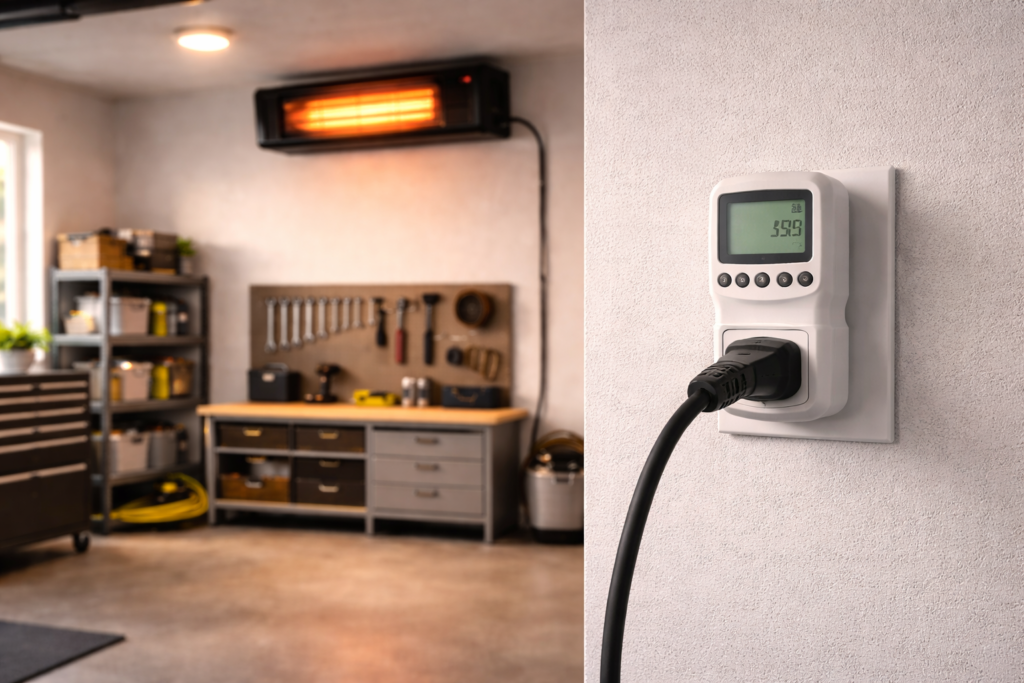
The cost to run an electric garage heater depends on three things:
• Heater wattage
• Hours of use
• Your local electricity rate
Electric heaters convert nearly all electricity into heat, so operating cost is straightforward to calculate.
The Basic Cost Formula
Use this simple formula:
(Watts ÷ 1,000) × Electricity Rate × Hours Used = Cost
Example:
A 5,000-watt heater running for 1 hour
Electricity rate: $0.15 per kWh
5,000 ÷ 1,000 = 5 kW
5 × $0.15 = $0.75 per hour
That means it costs about 75 cents per hour to run a 5,000-watt heater at that rate.
Typical Hourly Operating Costs
Here’s a rough estimate using $0.15 per kWh:
• 1,500 watts → ~$0.23 per hour
• 4,000 watts → ~$0.60 per hour
• 5,000 watts → ~$0.75 per hour
• 7,500 watts → ~$1.12 per hour
If your electricity rate is higher (for example $0.20–$0.25 per kWh), costs increase proportionally.
To understand what size heater you may need, review How Many Watts to Heat a Garage? before estimating long-term operating costs.
Monthly Cost Example
If you run a 5,000-watt heater:
• 3 hours per day
• 20 days per month
• At $0.15 per kWh
Calculation:
5 kW × 3 hours = 15 kWh per day
15 × 20 days = 300 kWh per month
300 × $0.15 = $45 per month
Actual costs vary based on climate and thermostat cycling.
Does the Heater Run Constantly?
Not usually.
Once the garage reaches the set temperature, the thermostat cycles the heater on and off.
In an insulated garage:
• The heater runs less frequently
• Monthly costs are lower
In an uninsulated garage:
• The heater runs longer
• Energy use increases
Improving insulation can reduce operating costs significantly.
120V vs 240V Operating Cost
A common misconception is that 240V heaters cost more to run.
Voltage does not determine cost — wattage does.
A 5,000-watt heater costs the same to run whether it’s powered by 240V or multiple 120V circuits.
The difference is electrical efficiency and capacity, not energy price.
If you’re unsure which setup fits your garage, see 120V vs 240V Electric Garage Heaters for clarification.
Ways to Reduce Running Costs
To keep operating expenses reasonable:
• Insulate walls and ceiling
• Seal garage door gaps
• Use a programmable thermostat
• Heat only when needed
• Choose the correct wattage (not oversized)
If the heater is too small, it may run continuously. If oversized, it may short cycle.
Choosing the correct unit size improves both comfort and cost control.
For selection guidance, start with How to Choose an Electric Garage Heater before purchasing.
Is Electric Heating Expensive Compared to Gas?
Electric heating typically costs more per hour than natural gas in many regions.
However:
• Installation is simpler
• No venting is required
• Maintenance is minimal
• No combustion risk exists
For small garages or occasional use, electric heaters are often practical and predictable in cost.
For smaller garages, choosing the right heater can also help keep running costs down. This guide compares the most efficient options:
Best Electric Garage Heater for Small Garages
Bottom Line
To estimate operating cost:
• Convert watts to kilowatts
• Multiply by your electricity rate
• Multiply by hours of use
For a typical two-car garage using a 5,000-watt heater, expect roughly $0.60–$1.00 per hour depending on electricity rates.
Insulation, thermostat use, and heater sizing all influence your final monthly cost.