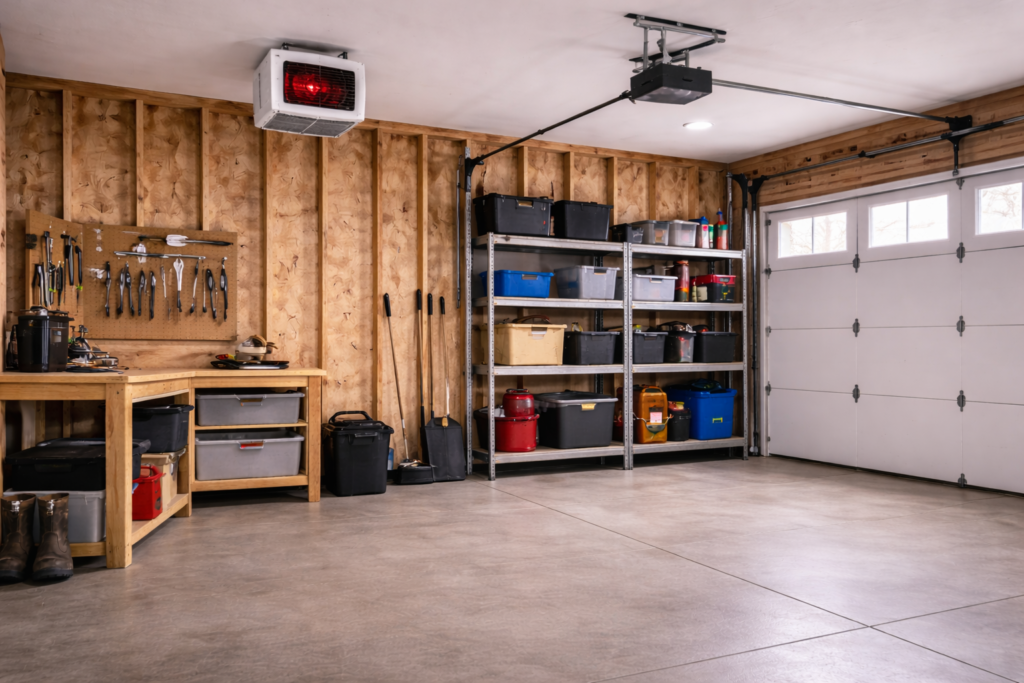
Introduction
Heating an uninsulated garage can be more challenging than heating a space that already has insulation in the walls and ceiling.
Without insulation, heat escapes much more quickly through the walls, ceiling, and garage door. As a result, a heater that works well in an insulated garage may struggle to warm an uninsulated space.
Understanding how insulation affects heating requirements can help you choose a heater that is capable of warming an uninsulated garage more effectively.
Why Uninsulated Garages Need More Heating Power
Insulation slows down heat loss. When a garage is not insulated, heat produced by a heater escapes quickly into the surrounding structure and outdoor air.
This means the heater must work harder to maintain the desired temperature.
Compared with an insulated garage of the same size, an uninsulated garage may require 25–50 percent more heating power.
For example, a garage that normally requires 4,000 watts of heating power may need 5,000–6,000 watts if it is not insulated.
Estimating Heater Size for an Uninsulated Garage
A common starting point for electric heating calculations is:
10 watts per square foot
However, when a garage is not insulated, it is usually better to increase that estimate.
A practical approach is:
12–15 watts per square foot
Example calculations:
• 300 sq ft garage → about 3,600–4,500 watts
• 400 sq ft garage → about 4,800–6,000 watts
• 500 sq ft garage → about 6,000–7,500 watts
These estimates provide a better starting point when insulation is limited.
For a full breakdown of how to calculate the correct heater size based on garage size, insulation, and ceiling height, see What Size Electric Heater Do I Need for My Garage.
Other Factors That Affect Heating Performance
Several additional factors influence how easily an uninsulated garage can be heated.
Ceiling Height
Higher ceilings increase the volume of air that must be heated.
Garages with ceilings higher than 9–10 feet may require more powerful heaters.
Garage Door Construction
Metal garage doors without insulation allow heat to escape quickly.
Insulated doors or weather sealing can significantly improve heating performance.
Outdoor Climate
Garages located in colder regions may require larger heaters to maintain comfortable temperatures.
Very cold outdoor air increases the rate at which heat escapes from the garage.
Air Gaps and Drafts
Small gaps around garage doors or windows can allow cold air to enter continuously.
Sealing these gaps can improve heater efficiency and reduce the amount of heating power required.
Types of Heaters That Work Best in Uninsulated Garages
Certain heater styles perform better in garages that lose heat quickly.
Common choices include:
• Ceiling-mounted electric garage heaters
• Wall-mounted fan heaters
• high-output electric shop heaters
These heaters circulate warm air throughout the garage and can help maintain a stable temperature even when heat loss occurs.
Portable heaters may still work in smaller spaces, but they may struggle to heat larger uninsulated garages.
Improving Heating Efficiency in an Uninsulated Garage
Even small improvements to insulation can make a noticeable difference.
Some helpful steps include:
• sealing gaps around the garage door
• installing weather stripping
• insulating the garage door panels
• adding basic wall insulation if possible
These changes can reduce heat loss and allow the heater to warm the space more efficiently.
Related Garage Heating Guides
For more information about heating garages, see these guides:
How Many Watts to Heat a Garage