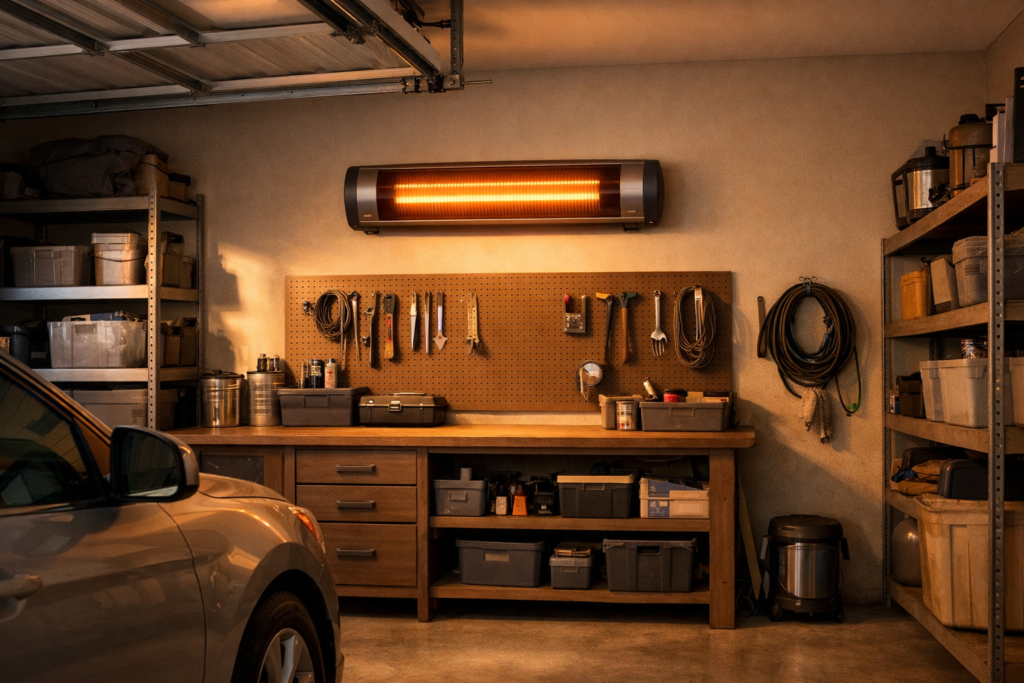
Choosing an electric garage heater is mostly about matching the heater to your space and how you actually use it. The right unit should heat your garage comfortably, operate safely on your available power supply, and fit the way you work.
In most garages, the key factors are size, insulation, voltage, and mounting type. This guide walks you through the main decisions step by step so you can avoid buying a heater that is too small, too powerful, or incompatible with your setup.
Quick Heater Selection Guide
Most garages require between 10 and 12 watts per square foot for effective heating, with higher wattage needed for colder climates or poor insulation.
- Small garages: portable or 120V heaters may be enough
- Medium garages: wall-mounted or 240V heaters are common
- Large garages: ceiling-mounted 240V heaters are usually required
If you are unsure about sizing, see What Size Electric Heater Do I Need for My Garage for a full breakdown.
Step 1: Measure Your Garage Size
Start by measuring the length and width of your garage and multiplying them to get square footage.
For example:
20 ft × 20 ft = 400 square feet
Garage size determines the baseline heating power required. Larger spaces need more wattage, but other factors like insulation and ceiling height also play a role.
Step 2: Understand Heater Power (Watts and BTUs)
Electric garage heaters are usually rated in watts, which is the easiest way to compare models.
- 10 watts per square foot for insulated garages
- 12–15 watts per square foot for colder or uninsulated spaces
Manufacturers may also list BTUs, but for electric heaters, focusing on wattage is usually sufficient.
A common mistake is choosing a heater based only on advertised coverage without checking the actual wattage output.
Step 3: Check Your Electrical Supply (120V vs 240V)
Before choosing a heater, confirm what type of power is available in your garage.
120V heaters plug into standard outlets but are typically limited to around 1,500 watts. These are best for small garages or spot heating.
240V heaters require a dedicated circuit but can provide 4,000 to 7,500 watts, making them suitable for most full-garage heating setups.
If your heater requirement is above 3,000–4,000 watts, a 240V unit is usually necessary.
For a detailed comparison, see 120V vs 240V Electric Garage Heaters.
Step 4: Choose the Right Mounting Type
Electric garage heaters are available in three main styles:
Portable Heaters
- Plug into standard outlets
- Easy to move
- Best for small garages or temporary heating
Wall-Mounted Heaters
- Fixed installation
- Save floor space
- Good for medium-sized garages
Ceiling-Mounted Heaters
- Mounted overhead
- Keep walls and floors clear
- Common in workshops and larger garages
In most working garages, mounted heaters are preferred because they reduce clutter and improve safety.
Step 5: Consider Insulation and Climate
Two garages of the same size can require very different heaters depending on insulation.
Well-insulated garages retain heat efficiently and can use lower wattage. Poorly insulated garages lose heat quickly and may require 20–50% more power.
Climate also matters. In colder regions, higher wattage or more efficient heaters are needed to maintain usable temperatures.
For more detail, see Heating an Uninsulated Garage: What to Expect.
Step 6: Look at Safety Features
Electric heaters are generally safer than gas units, but safety features still matter.
- Overheat protection
- Built-in thermostat
- Tip-over protection (portable units)
- Proper clearance guidelines
Always follow manufacturer spacing recommendations, especially around flammable materials.
Step 7: Heating Type (Fan vs Infrared)
Electric garage heaters use different heating methods.
Fan-forced heaters warm the air and circulate it throughout the garage. These are the most common choice for general use.
Infrared heaters warm objects and people directly, which can feel faster and more efficient if you work in a fixed area.
For a detailed comparison, see Infrared vs Fan-Forced Garage Heaters.
Step 8: Consider Noise Level
Fan-forced heaters produce some noise due to internal fans.
If your garage is used for a home gym, workshop, or hobby space, this may be a factor.
Ceiling-mounted heaters are often less noticeable because they are positioned overhead.
Step 9: Match Heater Size to Real Usage
A common mistake is choosing a heater based on maximum output rather than actual use.
In most garages, you do not need full indoor temperatures. Many users are comfortable working at 50–60°F.
A slightly oversized heater with a thermostat will cycle efficiently, while an undersized heater may run constantly and still struggle to keep up.
Common Mistakes When Choosing a Garage Heater
- Choosing based only on price
- Ignoring electrical limitations
- Underestimating insulation impact
- Buying a heater that is too small
Choosing the Right Heater for Your Setup
Once you understand your garage size, insulation, and electrical setup, the next step is selecting a model that fits your needs.
For example, small garages may work well with portable heaters, while larger garages often require ceiling-mounted or hardwired units.
You can explore options in Best Electric Garage Heaters and Best Electric Heater for Small Garages.
Quick Checklist Before Buying
- Garage size
- Insulation level
- Available voltage
- Circuit capacity
- Mounting preference
- Climate conditions
Final Thoughts
Choosing an electric garage heater is less about brand names and more about matching power, voltage, and installation style to your specific space.
Start with size, confirm your electrical supply, and consider insulation and climate. Then choose a heater type that fits how you actually use your garage.
For product recommendations, see Electric Garage Heater Reviews or Best Electric Garage Heater for Cold Climates.