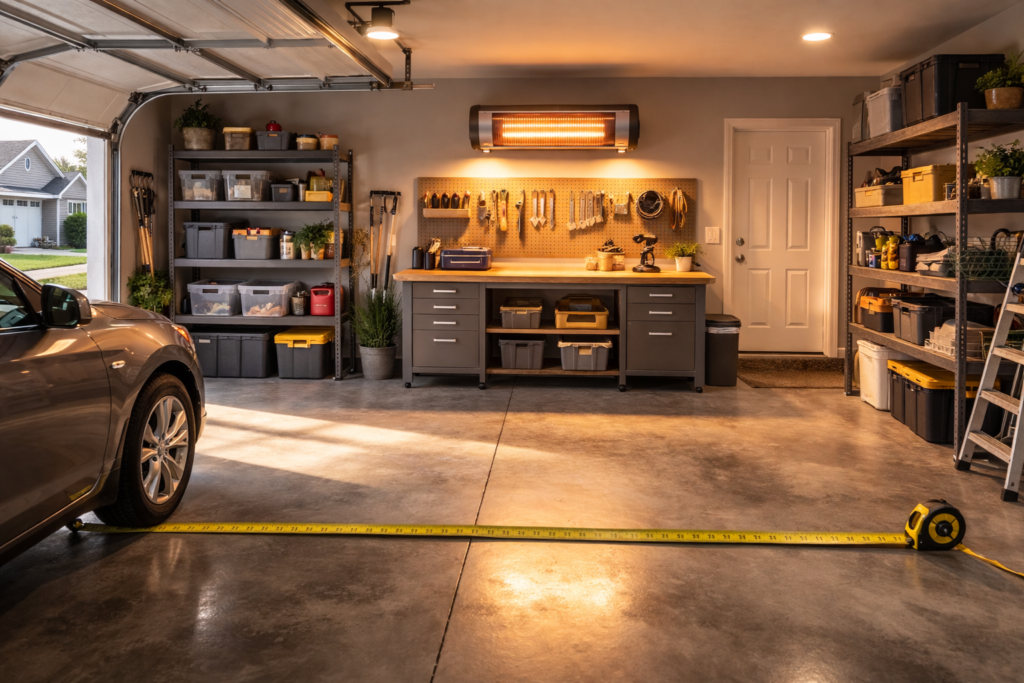
Choosing the correct heater size is the most important step in heating a garage effectively. If the unit is too small, it will run constantly and still feel cold. If it is too large, you may overpay for equipment and require electrical upgrades you do not need.
In most garages, heater size depends on square footage, insulation, ceiling height, and climate. This guide explains how to calculate the right size electric heater using simple, practical steps.
Quick Garage Heater Size Guide
As a general rule, most garages need between 8 and 12 watts per square foot to heat effectively. Smaller, insulated garages will be at the lower end of this range, while larger or uninsulated garages often require more power.
- Small insulated garage: 8–10 watts per sq ft
- Standard garage: 10–12 watts per sq ft
- Uninsulated or cold climates: 12–15 watts per sq ft
This provides a quick estimate, but real-world performance depends on several factors explained below.
Step 1: Measure Your Garage Square Footage
Start by calculating the floor area.
Measure the length and width of your garage in feet, then multiply the two numbers.
For example:
20 ft × 20 ft = 400 square feet
If your garage has higher ceilings (above 10 feet), this will affect heating requirements, which we cover below.
Step 2: Use the Basic Wattage Formula
Electric garage heaters are typically sized using wattage.
A simple rule of thumb is:
- 10 watts per square foot for a reasonably insulated garage in a moderate climate
- 12–15 watts per square foot for colder climates or poorly insulated garages
For example:
400 sq ft × 10 watts = 4,000 watts
400 sq ft × 12 watts = 4,800 watts (colder or less insulated)
This gives you a realistic target heater size for most situations.
For more detailed examples, see What Size Electric Heater for a 400 sq ft Garage or What Size Electric Heater for a 2 Car Garage.
How Garage Size Affects Heater Requirements
Garage size is the starting point for choosing a heater, but it is only part of the equation. Larger garages require more wattage to maintain a consistent temperature, especially in colder conditions.
A common mistake is assuming square footage alone determines heater size. In reality, two garages with the same size can require very different heaters depending on insulation and usage.
Step 3: Adjust for Ceiling Height
Most basic calculations assume an 8-foot ceiling.
If your garage has higher ceilings, open rafters, or loft space, you will need more heating power because there is more air volume to warm.
As a general adjustment, add 10–20% more wattage for ceilings above 10 feet.
For example:
4,000 watts × 1.15 = approximately 4,600 watts
In these setups, fan-forced or ceiling-mounted heaters can help distribute heat more evenly.
Why Insulation Makes a Big Difference
In most garages, insulation is the biggest factor affecting heating performance.
Well-insulated garages retain heat efficiently, allowing you to use a smaller heater while maintaining comfortable temperatures.
Poorly insulated garages lose heat quickly through walls, doors, and gaps. In these cases, you may need 20–50% more wattage to achieve the same result.
If your garage is uninsulated, see Heating an Uninsulated Garage: What to Expect for more detail.
Step 4: Consider Insulation Quality
Insulation varies widely between garages.
Well-insulated garages typically include:
- Insulated walls and ceilings
- Insulated garage door
- Drywall finished interior
- Weather-sealed gaps
Poorly insulated garages often include exposed framing, metal doors, or drafty gaps, which significantly increase heating demand.
Step 5: Climate Matters
Your local climate plays a major role in heater sizing.
In milder climates, a correctly sized heater will maintain temperature easily. In colder regions, additional wattage or a higher voltage system may be required to keep the space usable.
Many users aim for 50–60°F in a garage, rather than full indoor comfort levels.
If you are still deciding on heater type, see How to Choose an Electric Garage Heater.
Step 6: Understand Voltage Limitations
Heater size is closely tied to available voltage.
120V heaters typically max out around 1,500 watts and are best suited for small spaces or spot heating.
240V heaters commonly range from 4,000 to 7,500 watts and are required for most full-garage heating setups.
If your calculations exceed 3,000–4,000 watts, a 240V heater is usually necessary.
Common Garage Size Examples
Here are typical sizing scenarios:
- Single-car garage (240 sq ft): 2,500–3,000 watts
- Two-car garage (400 sq ft): 4,000–5,000 watts
- Large garage or workshop (576 sq ft): 5,000–7,500 watts
These are general estimates and should be adjusted for insulation and climate.
Common Garage Heater Sizing Mistakes
- Choosing a heater based only on square footage
- Ignoring insulation quality
- Using a 120V heater in a large garage
- Underestimating cold climate impact
A common issue is selecting a heater that is too small, which results in long heating times and inconsistent temperatures.
Avoid Undersizing
An undersized heater will run constantly, struggle to reach temperature, and waste electricity over time.
It is usually better to choose a heater slightly above your minimum requirement, especially if it includes a thermostat.
Avoid Oversizing Without Electrical Planning
Larger heaters may require dedicated circuits, proper breaker sizing, and electrical upgrades.
For example, a 5,000-watt 240V heater typically draws around 21 amps.
Always confirm your electrical capacity before installation.
Choosing the Right Heater for Your Garage Size
Once you have calculated your required wattage, the next step is choosing a heater that matches your setup.
Smaller garages may work well with portable or wall-mounted heaters, while larger garages often require ceiling-mounted or hardwired units.
You can explore suitable options in Best Electric Heater for Small Garages and Best Electric Heater for Large Garages.
Quick Sizing Checklist
- Square footage
- Ceiling height
- Insulation level
- Climate zone
- Available voltage
- Circuit capacity
Final Thoughts
Most standard two-car garages require between 4,000 and 5,000 watts in moderate climates.
Smaller garages may work with 2,500–3,000 watts, while larger or poorly insulated spaces may require 6,000 watts or more.
Start with square footage, adjust for insulation and ceiling height, and confirm your electrical capacity before choosing a heater.
Once you know your required size, the next step is selecting a suitable model. See Best Electric Garage Heater by Garage Size for a breakdown of options.