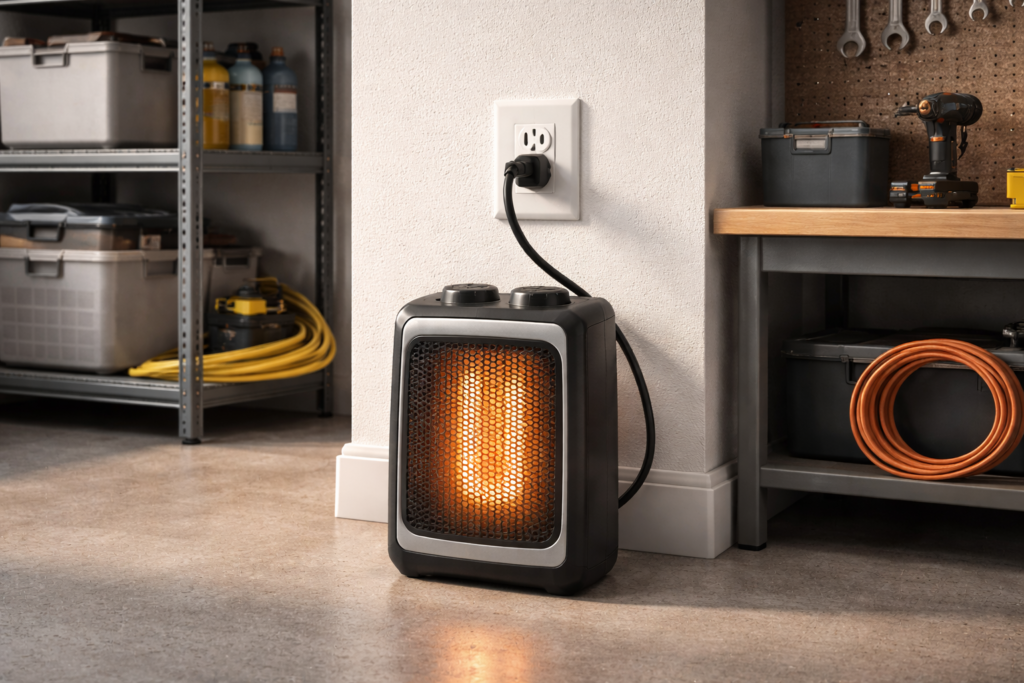
In many cases, yes — but only if the heater is designed for a standard 120-volt outlet.
The key factor is not just the plug shape. It’s how much power the heater draws and whether your garage circuit can handle it safely.
This article explains when a regular outlet is fine — and when it is not.
Understanding Standard Garage Outlets
Most US residential garages include standard 120V outlets on 15-amp or 20-amp circuits.
A typical 120V heater draws:
• 1,000 watts
• 1,250 watts
• 1,500 watts (maximum for most standard outlets)
A 1,500-watt heater pulls about 12.5 amps. On a 15-amp circuit, that’s close to the limit.
If other tools, lights, or appliances are on the same circuit, the breaker may trip.
Before choosing a heater, it helps to understand 120V vs 240V Electric Garage Heaters so you know which voltage your space can support.
When It’s Safe to Use a Regular Outlet
You can safely plug a heater into a standard outlet if:
• The heater is rated for 120V
• It draws 1,500 watts or less
• It is plugged directly into the wall (no extension cord)
• The circuit is not heavily loaded
• The outlet and wiring are in good condition
Small portable garage heaters are typically designed for this setup.
When a Regular Outlet Is NOT Enough
A standard outlet is not suitable if:
• The heater requires 240V
• The unit exceeds 1,500 watts
• The breaker trips repeatedly
• The wiring feels warm
• You need to heat a large garage space
Larger wall-mounted and ceiling-mounted units often require a dedicated 240V circuit.
If you’re unsure whether 120V is enough for your garage size, see What Size Electric Heater Do I Need for My Garage? to avoid underpowering or overloading your space.
Why Extension Cords Are a Problem
Extension cords increase resistance and heat buildup.
Even heavy-duty cords can become warm under continuous load. This increases fire risk.
Best practice:
• Plug directly into a wall outlet
• Avoid power strips
• Avoid shared circuits with heavy equipment
If you must use a cord temporarily, it should be heavy-gauge and rated for the heater’s amperage — but permanent setups should always use direct wall connections.
What Happens If You Overload the Circuit?
When too much current flows:
• The breaker trips
• The heater shuts off
• Wiring may overheat if the breaker fails
Repeated breaker trips are a sign the circuit is overloaded.
That does not necessarily mean the heater is defective — it often means the electrical supply is insufficient for the heater’s output.
If your heater keeps shutting off, it may be overloading the circuit—see why your garage heater trips the breaker
Is 120V Heating Enough for a Garage?
For small garages (one-car, mild climates), a 120V heater may be sufficient.
For larger spaces or colder regions, 240V units provide:
• Higher wattage
• Faster heating
• More consistent temperature control
Choosing between them depends on garage size, insulation, and electrical capacity. A good starting point is How to Choose an Electric Garage Heater, which explains how layout and power supply influence your decision.
Bottom Line
You can plug an electric garage heater into a regular outlet — but only if:
• It is designed for 120V
• The circuit can handle the load
• You plug directly into the wall
• You avoid extension cords
If you need more heat than a standard outlet can safely provide, a 240V unit with a dedicated circuit is the safer long-term solution.
For smaller garages, plug-in heaters can sometimes be a practical option. This guide compares the most suitable choices:
Best Electric Garage Heater for Small Garages