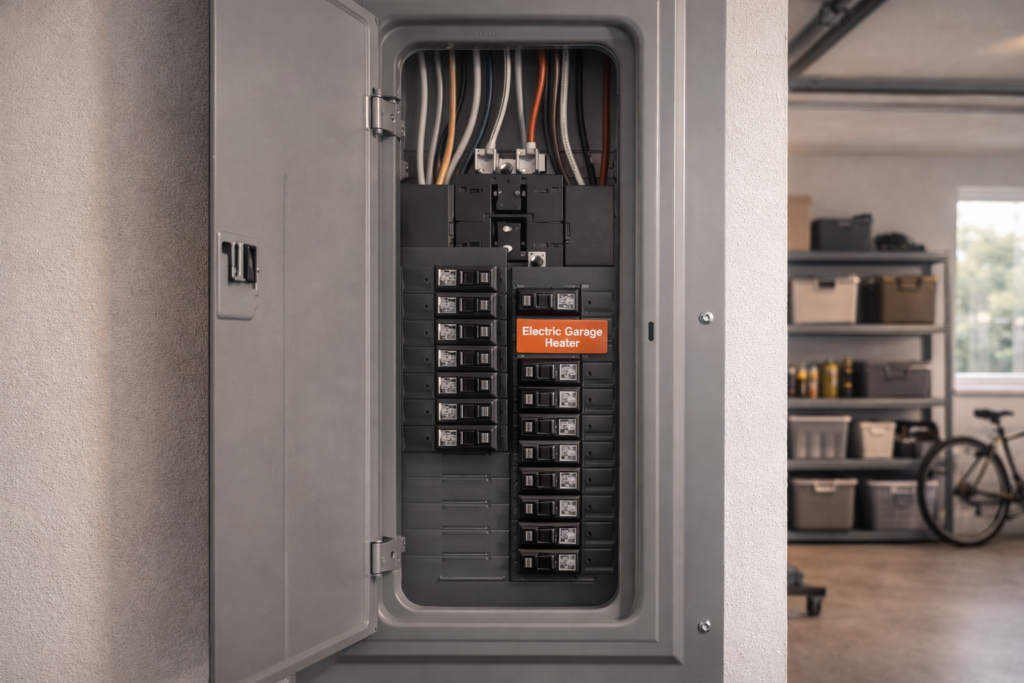
In many cases, yes — especially for larger electric garage heaters.
Whether you need a dedicated circuit depends on three things:
• The heater’s wattage
• The voltage (120V or 240V)
• What else is running on the same circuit
Small plug-in heaters may work on an existing outlet. Larger wall-mounted or ceiling-mounted units almost always require a dedicated circuit.
What Is a Dedicated Circuit?
A dedicated circuit is an electrical line that serves only one appliance.
That means:
• One breaker in your panel
• One wiring run
• One connected device
Nothing else shares that circuit.
This prevents overload and reduces the risk of overheating wires or constantly tripping breakers.
When a Dedicated Circuit Is NOT Required
You may not need a dedicated circuit if:
• The heater is 120V
• It draws 1,500 watts or less
• The outlet is on a lightly used circuit
• No other heavy tools run at the same time
Most portable electric garage heaters fall into this category.
However, even 1,500 watts draws about 12.5 amps. On a standard 15-amp circuit, that leaves very little capacity for anything else.
If lights, freezers, or power tools share the circuit, breaker trips can become common.
If you’re unsure about voltage limits, review 120V vs 240V Electric Garage Heaters before choosing a model.
When a Dedicated Circuit IS Required
You will almost always need a dedicated circuit if:
• The heater is 240V
• The wattage exceeds 2,000 watts
• The unit is hardwired
• The manufacturer specifies a dedicated breaker
• Breakers trip repeatedly
Most 4,000–7,500 watt garage heaters require a dedicated 240V circuit installed directly from the breaker panel.
This is common for:
• Two-car garages
• Cold climate installations
• Permanently mounted heaters
Why Larger Heaters Need Their Own Circuit
Electrical circuits have limits.
A 240V heater drawing 5,000 watts pulls about 21 amps. That requires a properly sized breaker and wiring.
Sharing that load with other equipment would:
• Overheat wiring
• Trip breakers
• Increase fire risk
A dedicated circuit ensures the heater receives stable power without stressing your electrical system.
Breaker trips are often caused by circuit overload—see why your garage heater trips the breaker for a full explanation
What Happens If You Don’t Use One?
If a heater that requires a dedicated circuit is placed on a shared line, you may experience:
• Frequent breaker trips
• Dimming lights
• Warm outlets
• Reduced heater performance
Repeated tripping is not just inconvenient — it signals that the circuit is overloaded.
Ignoring this can damage wiring over time.
How Wattage Determines Circuit Needs
Wattage directly affects amperage draw.
Here’s a simplified reference:
• 1,500 watts (120V) → ~12.5 amps
• 4,000 watts (240V) → ~16–17 amps
• 5,000 watts (240V) → ~21 amps
• 7,500 watts (240V) → ~31 amps
As wattage increases, the need for a dedicated breaker becomes more likely.
If you’re unsure how many watts your garage needs in the first place, see How Many Watts to Heat a Garage? before planning electrical work.
Should You Hire an Electrician?
For hardwired 240V installations, yes.
A licensed electrician can:
• Confirm panel capacity
• Size the breaker correctly
• Install proper wiring
• Ensure code compliance
This is especially important in attached garages where safety standards are stricter.
Bottom Line
You need a dedicated circuit for a garage heater if:
• It is 240V
• It exceeds roughly 2,000 watts
• It is permanently mounted
• The manufacturer requires it
Small 120V plug-in heaters may work on existing outlets — but only if the circuit is not shared with heavy equipment.
Correct electrical planning improves performance, prevents nuisance breaker trips, and reduces fire risk.