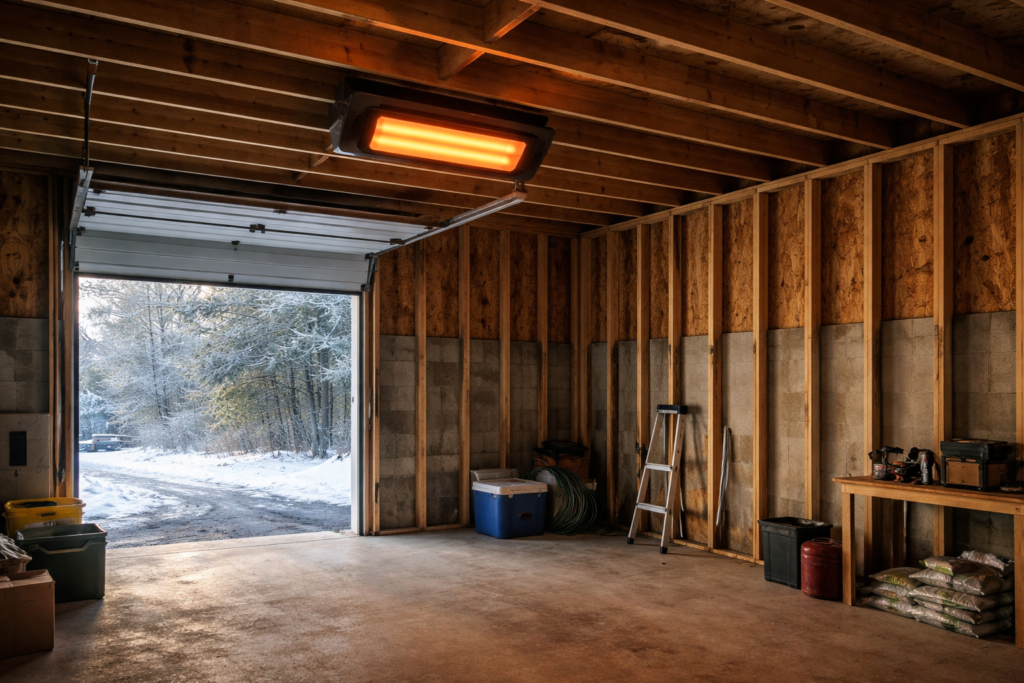
Heating an uninsulated garage is possible — but you should expect slower warm-up times, higher electricity use, and more temperature fluctuation.
Without insulation, heat escapes quickly through:
• Garage doors
• Concrete walls
• Exposed ceiling rafters
• Gaps and drafts
Before buying a larger heater, it helps to understand what changes when insulation is missing.
Why Uninsulated Garages Lose Heat Quickly
Garages are often built without:
• Insulated walls
• Insulated ceilings
• Sealed door panels
Concrete and metal surfaces transfer heat easily. That means warm air produced by the heater escapes almost as fast as it’s generated.
Even a properly sized heater will cycle more often in these conditions.
If you’re unsure how much power your space requires, start with How Many Watts to Heat a Garage? before choosing a unit.
Expect Higher Wattage Requirements
The common guideline of 10 watts per square foot assumes some insulation.
For an uninsulated garage, you may need:
• 12–15 watts per square foot
• A higher-output heater
• Longer run times
For example:
A 500 sq ft insulated garage → ~5,000 watts
A 500 sq ft uninsulated garage → 6,000–7,500 watts
Even then, the heater may struggle during very cold weather.
If you’re trying to heat a garage in very cold conditions, choosing the right heater makes a significant difference. This guide covers the most effective options:
Best Electric Garage Heater for Cold Climates
Slower Warm-Up Times
In an insulated garage, heat builds gradually and stays contained.
In an uninsulated garage:
• Cold surfaces absorb heat
• Air temperature drops quickly when the heater shuts off
• Warm-up may take 20–40 minutes or longer
If you only use your garage occasionally, you may need to turn the heater on well before starting work.
Higher Operating Costs
Because the heater runs longer, energy costs increase.
The heater may:
• Run continuously in extreme cold
• Cycle frequently
• Use significantly more electricity per month
To estimate monthly costs, review How Much Does It Cost to Run an Electric Garage Heater? before deciding on wattage.
120V vs 240V in Uninsulated Garages
Small 120V heaters (1,500 watts) are usually not sufficient for larger uninsulated garages.
They may:
• Struggle to raise temperature
• Only provide spot heating
• Run constantly
In most two-car uninsulated garages, a 240V heater in the 4,000–7,500 watt range is more realistic.
If you’re deciding between voltage options, see 120V vs 240V Electric Garage Heaters to understand capacity differences.
When Insulation Is the Better Investment
In many cases, improving insulation is more effective than increasing heater size.
Adding insulation to:
• Garage door panels
• Wall cavities
• Ceiling spaces
can significantly reduce required wattage and operating cost.
Even sealing gaps around the garage door can make a noticeable difference.
Is It Worth Heating an Uninsulated Garage?
It depends on your goal.
If you want:
• Occasional comfort while working → Higher wattage may be enough
• Full winter temperature control → Insulation upgrades are strongly recommended
Without insulation, you should expect:
• Uneven temperatures
• Higher energy use
• Less efficient heating
Larger garages without insulation can be especially difficult to heat. This guide looks at the best high-output heater options:
Best Electric Garage Heater for Large Garages
Bottom Line
Heating an uninsulated garage is possible — but expect:
• Increased wattage requirements
• Longer warm-up times
• Higher operating costs
• Greater temperature swings
Before purchasing a larger heater, consider whether adding insulation could reduce both upfront and long-term costs.
Correct sizing combined with even basic insulation improvements usually delivers the best results.
Many people find that poor insulation is the main reason a heater struggles—see electric garage heater not heating enough for a full breakdown